Ìèíèñòð èíîñòðàííûõ äåë Ôðàíöèè Áåðíàð Êóøíåð çàÿâèë, âûñòóïàÿ â Èîðäàíèè, ÷òî Èçðàèëü äîëæåí ñâåðíóòü ñòðîèòåëüñòâî â ïîñåëåíèÿõ è ñäåëàòü äðóãèå øàãè íàâñòðå÷ó ïàëåñòèíñêîìó ëèäåðó. _________________ A la guerre comme a la guerre èëè âòîðàÿ ðåäàêöèÿ Çàáóãîðíîâà
Ýòî âåðíî, ñ åäèíñòâåííîé ïîïðàâêîé: îòêóäà ñëåäóåò ÷òî íûíåøíÿÿ âëàñòü - ñëàáàÿ? _________________ A la guerre comme a la guerre èëè âòîðàÿ ðåäàêöèÿ Çàáóãîðíîâà
Ýòî óòâåðæäåíèå, î íåïîíèìàíèè, íå âûäåðæèâàåò íèêàêîé êðèòèêè. Ïðîñòîé ïðèìåð. Íåòàíèÿãó ìíîãî ðàç ëåòàë â Ïàðèæ (ïîñëåäíèé ðàç ñîâñåì íåäàâíî) ÷òîáû îáñóäèòü ïðîáëåìû â ðåãèîíå ñ Ñàðêîçè. Ñòàë áû îí ýòî äåëàòü åñëè áû Ñàðêîçè/Êóøíåð íè÷åãî íå ïîíèìàëè â äàííîì âîïðîñå? Âîïðîñ ðèòîðè÷åñêèé.... _________________ A la guerre comme a la guerre èëè âòîðàÿ ðåäàêöèÿ Çàáóãîðíîâà
À Ëèâíè íå íàøëà íè÷åãî óìíåå ÷åì ïûòàòüñÿ äàâèòü íà Øâåöèþ, äà åù¸ ïóáëè÷íî. Íî õîðîøî õîòü ñëîâàìè, à òî âåäü ìîãëà è ñàíêöèÿìè ïðèãðîçèòü...
Livni to Sweden: Ditch EU plan on dividing Jerusalem
By Barak Ravid, Haaretz Correspondent
Tags: division of Jerusalem, EU
Opposition leader Tzipi Livni on Tuesday urged Sweden's foreign minister, Carl Bildt, to abandon an EU plan to issue an official call for the division of Jerusalem between Israel and the Palestinians.
"I wish to convey my deep concern regarding what appears to be an attempt to prejudge the outcome of issues reserved for permanent status negotiations," Livni, a former foreign minister, wrote to Bilt.
Livni sent the letter in response to Haaretz's report that EU foreign ministers are expected to call next week for Jerusalem to be divided, in order to serve as the capitals of both Israel and a future Palestinian state.
Advertisement
A draft documentauthored by Sweden, the current holder of the rotating EU presidency, implies that the EU would also recognize a unilateral Palestinian declaration of statehood.
The opposition leader added: "Assuming the recent media reports are accurate, I want to urge you, in your capacity as EU President and as Swedish Foreign Minister, to refrain from adopting any position on Jerusalem.
"Whatever the intention of the Council's conclusions, I believe that any attempt to dictate for either party the nature of the outcome on the status of Jerusalem, is not helpful and wrong."
Earlier Tuesday, the Foreign Ministry lashed out at the plan, saying such a move would harm the chances of renewing Middle East peace negotiations.
"The process being led by Sweden harms the European Union's ability to take part as a significant mediator in the political process between Israel and the Palestinians," the ministry said in a statement.
"After the important steps taken by the government of Israel to enable the resumption of negotiations with the Palestinians, the European Union must now exert pressure on the Palestinians to return to the negotiating table. Steps like those being led by Sweden only contribute to the opposite effect," said the statement.
Jerusalem is waging a diplomatic campaign to keep the EU from issuing such an endorsement, but diplomats close to the EU deliberations believe it is almost inevitable.
The EU foreign ministers are scheduled to meet on December 7 for a two-day meeting in Brussels on the peace process, after which a statement outlining the body's Mideast policy is expected.
The Swedish draft represents the first official EU articulation of a solution for one of the core issues of the final-status arrangement between Israel and the Palestinians.
The document expressed the EU's concern over the stalemate in the peace process and calls for the immediate renewal of negotiations between Israel and the Palestinian Authority in accordance with a prescribed timetable. The goal, it states, is "an independent, democratic, contiguous and viable state of Palestine, comprising the West Bank and Gaza and with East Jerusalem as its capital."
The draft refers directly to the situation in East Jerusalem, calling on "all parties to refrain from provocative actions" and stating the EU Council "has never recognized the annexation of East Jerusalem. If there is to be a genuine peace, a way must be found to resolve the status of Jerusalem as capital of two states. The Council calls for the reopening of Palestinian institutions in Jerusalem in accordance with the road map. It also calls on the Israeli government to cease all discriminatory treatment of Palestinians in East Jerusalem."
The document deals only briefly with Israel's announcement of a 10-month moratorium on construction in settlements across the West Bank: "The Council takes note of the recent decision of the government of Israel on a partial and temporary permanent freeze and expresses the hope that it will become a step towards resuming meaningful negotiations." Israel's removal of checkpoints also receives only cursory mention: "Many checkpoints and roadblocks remain in place to protect settlements."
On the issue of borders, the document states that the EU will not accept any changes made by Israel to the 1967 borders unless they have PA approval. The EU, it says, welcomes PA Prime Minister Salam Fayyad's proposal of a unilateral declaration of statehood and would "be able, at the appropriate time, to recognize a Palestinian state."
Israeli diplomats have been following the Swedish initiative for several weeks. Israel's Brussels-based ambassador to the EU, Ran Kuriel, sent several messages to Jerusalem last week accusing Sweden of leading the union on a "collision course" with Israel. Kuriel wrote that Britain and France support the Swedish position, while Germany, Spain and Italy are disinclined to side with Israel on the matter.
Senior Foreign Ministry officials said the belief is widespread across the foreign policy echelon that Sweden is advancing an explicitly "anti-Israel" line, rendering Europe "irrelevant" to the peace process.
European diplomats privy to the negotiations said that although changes favorable to Israel had been made to the draft, there is virtually no chance of preventing the EU from calling for the division of Jerusalem. They said they believe the EU statement will help Palestinians return to negotiations with Israel, as it gives them guarantees of a Palestinian capital in Jerusalem even though Israel has not frozen construction there. _________________ A la guerre comme a la guerre èëè âòîðàÿ ðåäàêöèÿ Çàáóãîðíîâà
The United States fell short in its efforts to gain a declaration of international support for Israel's temporary settlement construction freeze. The Americans were hoping that its partners in the Quartet - Russia, the European Union and the United Nations - would agree to such a declaration, but Moscow expressed a series of reservations and foiled Washington's effort.
Last Thursday, a day after the security-political cabinet decided to put a moratorium on construction in settlements for a 10 month period, a conference call was held at the highest levels among Quartet members. In addition to Secretary of State Hillary Clinton, UN Secretary General Ban Ki-moon, Europe's outgoing foreign affairs chief, Javier Solana, and Russia's foreign minister, Sergey Lavrov, were also on line.
Clinton proposed that the Quartet issue a joint statement of support for the Israeli decision to freeze construction. The other participants agreed and decided to let officials from each side formulate the announcement.
Advertisement
Heading the team tasked with formulating the statement was U.S. diplomat, David Hale, deputy to U.S. special envoy to the Middle East George Mitchell.
Hale initiated exchanges with his colleagues in the EU, the UN and Russia, but it quickly became clear that there was no agreement on the content of the statement.
Senior Israeli and American officials say that Russia was responsible for foiling the announcement, by expressing many reservations to the text proposed by the Americans - which was reportedly very short. At the crux of the Russian objections were two points that were very important to the U.S. administration: the Jewish identity of the State of Israel, and that the future border between Israel and the Palestinians would reflect developments on the ground.
The Americans proposed that the Quartet's announcement be based on the statement issued by Secretary of State Clinton last week, supporting the announcement of Prime Minister Benjamin Netanyahu on the freeze.
The proposed version called for the resumption of negotiations without preconditions so that an agreement could be reached which "would fulfill the Palestinian goal of establishing an independent, viable state, based on the 1967 borders, agreed upon exchanges [of territory], and the Israeli goal of a Jewish state with secure and recognized borders that reflect the developments [which occurred on the ground] and which fulfill the Israeli security requirements."
The Russians argued that they did not agree with stating that Israel will be a Jewish State, and that the borders will be altered on the basis of "developments" on the ground, namely Israeli annexation of the large settlement blocks.
The Russians stressed that such formulation of the Quartet's text predetermines the results of the negotiations.
Once efforts to convince the Russians failed, the Americans decided that there was no point in issuing a statement. A senior U.S. administration official told Haaretz that the without a consensus among the members of the Quartet, it would be impossible to issue a statement for the whole group. _________________ A la guerre comme a la guerre èëè âòîðàÿ ðåäàêöèÿ Çàáóãîðíîâà
http://www.consilium.europa.eu/uedocs/cms_data/docs/pressdata/EN/foraff/111829.pdf Council conclusions on
the Middle East Peace Process
2985th FOREIGN AFFAIRS Council meeting
Brussels, 8 December 2009
The Council adopted the following conclusions:
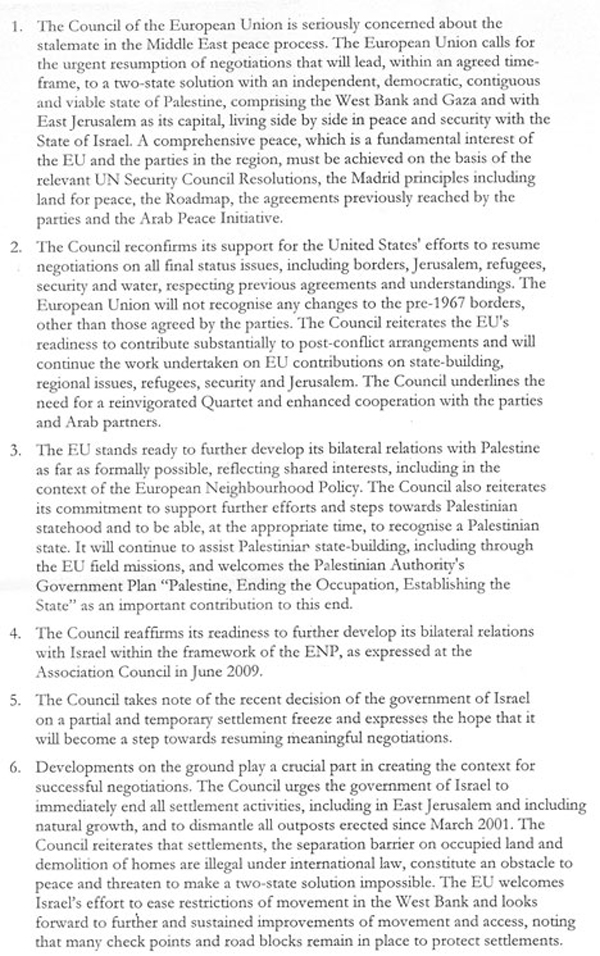
1. The Council of the European Union is seriously concerned about the lack of progress in the
Middle East peace process. The European Union calls for the urgent resumption of
negotiations that will lead, within an agreed time-frame, to a two-state solution with the State
of Israel and an independent, democratic, contiguous and viable State of Palestine, living side
by side in peace and security. A comprehensive peace, which is a fundamental interest of the
parties in the region and the EU, must be achieved on the basis of the relevant UN Security
Council Resolutions, the Madrid principles including land for peace, the Roadmap, the
agreements previously reached by the parties and the Arab Peace Initiative.
2. The Council reconfirms its support for the United States' efforts to resume negotiations on all
final status issues, including borders, Jerusalem, refugees, security and water, respecting
previous agreements and understandings. The European Union will not recognise any changes
to the pre-1967 borders including with regard to Jerusalem, other than those agreed by the
parties. The Council reiterates the EU's readiness to contribute substantially to post-conflict
arrangements, aimed at ensuring the sustainability of peace agreements, and will continue the
work undertaken on EU contributions on state-building, regional issues, refugees, security and
Jerusalem. The Council underlines the need for a reinvigorated Quartet engagement and notes
the crucial importance of an active Arab contribution building on the Arab Peace Initiative.
2
EN
3. The EU stands ready to further develop its bilateral relations with the Palestinian Authority
reflecting shared interests, including in the framework of the European Neighbourhood
Policy. Recalling the Berlin declaration, the Council also reiterates its support for negotiations
leading to Palestinian statehood, all efforts and steps to that end and its readiness, when
appropriate, to recognise a Palestinian state. It will continue to assist Palestinian statebuilding,
including through its CSDP missions and within the Quartet. The EU fully supports
the implementation of the Palestinian Authority's Government Plan "Palestine, Ending the
Occupation, Establishing the State" as an important contribution to this end and will work for
enhanced international support for this plan.
4. Recalling the EU's position as expressed at the Association Council in June 2009, the Council
reaffirms its readiness to further develop its bilateral relations with Israel within the
framework of the ENP. The EU reiterates its commitment towards the security of Israel and
its full integration into the region, which is best guaranteed through peace between Israel and
its neighbours.
5. Encouraging further concrete confidence building measures, the Council takes positive note
of the recent decision of the Government of Israel on a partial and temporary settlement freeze
as a first step in the right direction and hopes that it will contribute towards a resumption of
meaningful negotiations.
6. Developments on the ground play a crucial part in creating the context for successful
negotiations. The Council reiterates that settlements, the separation barrier where built on
occupied land, demolition of homes and evictions are illegal under international law,
constitute an obstacle to peace and threaten to make a two-state solution impossible. The
Council urges the government of Israel to immediately end all settlement activities, in East
Jerusalem and the rest of the West Bank and including natural growth, and to dismantle all
outposts erected since March 2001.
7. The EU welcomes Israel’s steps to ease restrictions of movement in the West Bank which
have made a contribution to economic growth. The Council calls for further and sustained
improvements of movement and access, noting that many check points and road blocks
remain in place. The Council also calls on the Palestinian Authority to build on its efforts to
improve law and order.
8. The Council is deeply concerned about the situation in East Jerusalem. In view of recent
incidents, it calls on all parties to refrain from provocative actions. The Council recalls that it
has never recognised the annexation of East Jerusalem. If there is to be a genuine peace, a
way must be found through negotiations to resolve the status of Jerusalem as the future capital
of two states. The Council calls for the reopening of Palestinian institutions in Jerusalem in
accordance with the Roadmap. It also calls on the Israeli government to cease all
discriminatory treatment of Palestinians in East Jerusalem.
3
EN
9. Gravely concerned about the situation in Gaza, the Council urges the full implementation of
UNSCR 1860 and the full respect of international humanitarian law. In this context, the
continued policy of closure is unacceptable and politically counterproductive. It has
devastated the private sector economy and damaged the natural environment, notably water
and other natural resources. The EU again reiterates its calls for an immediate, sustained and
unconditional opening of crossings for the flow of humanitarian aid, commercial goods and
persons to and from Gaza. In this context, the Council calls for the full implementation of the
Agreement on Movement and Access. While extremists stand to gain from the current
situation, the civilian population, half of which are under the age of 18, suffers. Fully
recognising Israel's legitimate security needs, the Council continues to call for a complete stop
to all violence and arms smuggling into Gaza. The Council calls on those holding the
abducted Israeli soldier Gilad Shalit to release him without delay.
10. The Council calls on all Palestinians to promote reconciliation behind President Mahmoud
Abbas, support for the mediation efforts by Egypt and the Arab League and the prevention of
a permanent division between the West Bank, including East Jerusalem, and Gaza. The
Council would welcome the organisation of free and fair Palestinian elections when
conditions permit.
11. A comprehensive peace must include a settlement between Israel and Syria and Israel and
Lebanon. Concerning the Syrian track, the EU welcomes recent statements by Israel and Syria
confirming their willingness to advance towards peace and supports all efforts aimed at the
reactivation of the talks between the two countries.
12. The EU recalls that a comprehensive settlement of the Arab-Israeli conflict requires a regional
approach and will continue its work on this in line with the June 2009 Council Conclusions
using all its instruments to this effect. The EU also calls on all regional actors to take
confidence building measures in order to stimulate mutual trust and encourages Arab
countries to be forthcoming, both politically and financially, in assisting the Palestinian
Authority and to Palestinian refugees through UNRWA.
_________________ _________________ A la guerre comme a la guerre èëè âòîðàÿ ðåäàêöèÿ Çàáóãîðíîâà
Palestinian Prime Minister Salam Fayyad said on Saturday that the foundation for peace and stability in the Middle East remains "the establishment of a Palestinian state on all territories occupied in 1967, chief among them East Jerusalem."
Fayyad was speaking at the "National Conference for the Strengthening of Popular Activity," which convened on Saturday in Ramallah. The event is being attended by senior Palestinian Authority officials.
The conference comes in the wake of a series of declarations made by Fatah officials, according to which the movement has taken a strategic decision to launch a third intifada.
Advertisement
Fatah is calling on Palestinians to stage wide-scale, grassroots demonstrations in the West Bank against settlements and the separation fence, though the party insists that Palestinians are not to undertake armed struggle.
"We strenuously reject all the solutions being proposed by Israel's leaders, [namely] solutions involving interim arrangements," Fayyad said Saturday in Ramallah. "We have no intention of continuing with the formula of interim arrangements and of accepting a state of swaths of territory that have no territorial contiguity."
"We learned the lessons of the first popular intifada and its results," Fayyad said. "We will act to reach a comprehensive agreement on the basis of resolutions by the international community and we will reject every attempt to once again enter this whirlwind of negotiations without results and long-term interim arrangements." _________________ A la guerre comme a la guerre èëè âòîðàÿ ðåäàêöèÿ Çàáóãîðíîâà
Ãëàâà ãðå÷åñêîé ïðàâîñëàâíîé öåðêâè ïàòðèàðõ Ôåîôèë III, ñî ñâîåé ñòîðîíû, ñêàçàë, ÷òî õðèñòèàíñêèå êîíôåññèè ãîòîâû ðàäè ïðîäâèæåíèÿ ìèðíîãî ïðîöåññà ñäåëàòü âñå, ÷òî â èõ ñèëàõ. _________________ A la guerre comme a la guerre èëè âòîðàÿ ðåäàêöèÿ Çàáóãîðíîâà


 FAQ
FAQ Ïîèñê
Ïîèñê Ïîëüçîâàòåëè
 Ãðóïïû
 Ðåãèñòðàöèÿ
 Ïðîôèëü
 Âîéòè è ïðîâåðèòü ëè÷íûå ñîîáùåíèÿ
 Âõîä
Âõîä


 ...Íàïðèìåð,.à ÷òî Èçðàèëü