As the Internet industry continues to expand in China, the government continues to tighten controls on on-line expression. As recently as July 11, 2001, President Jiang Zemin condemned the spread of "pernicious information" on the Net and called existing legislation "inadequate." (1) Since 1995, when Chinese authorities began permitting commercial Internet accounts, at least sixty sets of regulations have been issued aimed at controlling Internet content. The broadly-worded regulations represent a clear violation of the right to freedom of expression, and the government is devoting considerable time and resources to trying to implement them. (2)
As of January 2001, sending "secret" or "reactionary" materials over the Internet became a capital crime. Generally, however, persons convicted for their use of the Internet have received sentences of between two and four years, and we are not aware of anyone having been charged under Internet-specific regulations. Instead, they have all been found guilty of violating provisions of the Criminal Code. The elaborate regulatory framework serves, however, as a statement of policy, a justification for monitoring and surveillance, a set of guidelines for what constitutes "illegal" activity, and a deterrent to Internet users.
The government's determination to censor on-line content has grown with Internet usage. Improved infrastructure, introduction of mobile phones, and other low-cost methods of connection to the Internet, as well as increased local language content, have fueled that growth. The main contact points connecting China's Internet system with the worldwide system consists of nine so-called Internet Access Providers controlling the physical lines to the outside world. By July 2001 these access providers accommodated some 620 Internet Service Providers (ISPs) who served in turn some 1,600 Internet Content Providers (ICPs) and an estimated 26,000,000 users by the government's own conservative estimates. (3)
This backgrounder examines the development of China's repressive regulatory framework, its surveillance and closures of Internet cafés, and the detention of Internet users. _________________ A la guerre comme a la guerre èëè âòîðàÿ ðåäàêöèÿ Çàáóãîðíîâà
http://www.novexcn.com/state_secrey_internet.html
Article 10. Units and users that establish an BBS, chat room or network news group shall be verified and approved by the relevant organizations to clarify the requirements and responsibilities concerning the protection of secrets.
Áëèí.....Áûë áû íàø Ôîðóì â Êèòàå - îí íå âûæèë áû. Ïðèõëîïíóëè áû Çàáóãîðíîâà êàê ìóõó, Çàáóãîðíîâ òî íèêàêèõ ðàçðåøåíèé îò êîìïåòåíòíûõ îðãàíîâ íå ïîëó÷àë...Äàæå è íå çíàåò, êàêèå-òàêèå relevant organizations..... _________________ A la guerre comme a la guerre èëè âòîðàÿ ðåäàêöèÿ Çàáóãîðíîâà
http://www.lemonde.fr/web/article/0,1-0@2-651865,36-741960@51-730341,0.html
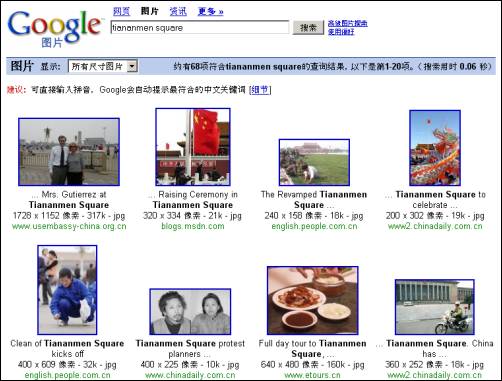
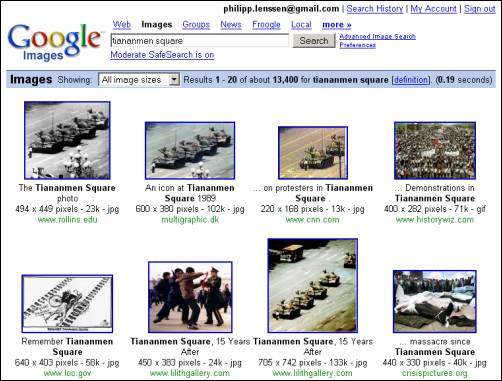
"Le représentant républicain Jim Leach a évoqué la création par Google, fin janvier, d'un moteur de recherches spécial, Google.cn, qui censure les sites dont Pékin souhaite rendre le contenu partiellement ou totalement inaccessibles aux internautes chinois. "C'est étonnant, a-t-il estimé : Google s'est pratiquement comporté comme un fonctionnaire du gouvernement chinois." Son collègue Christopher Smith a montré la différence de résultat selon qu'il lançait une recherche avec le nom de la place "Tiananmen" sur le moteur de recherche normal ou sur Google.cn : à la place des chars, on n'aperçoit, sur les photos, que des touristes souriants."


 FAQ
FAQ Ïîèñê
Ïîèñê Ïîëüçîâàòåëè
 Ãðóïïû
 Ðåãèñòðàöèÿ
 Ïðîôèëü
 Âîéòè è ïðîâåðèòü ëè÷íûå ñîîáùåíèÿ
 Âõîä
Âõîä